Curiosity
Lobelia's job is to hunt and kill God. It's not that hard, most of the time.
“I am a stupid God. A stupid, stupid God.”
Lobelia tried not to squint. It was a tell, a give-away. That’s what Supervisor said, and Supervisor was probably right. No, Supervisor was always right. So the creases of her eyes did not flicker as she stared at the man stopped on the pavement before her.
Could be thirty. Could be fifty, but no older, and oddly no enhancements that she could easily see. His long dark hair stuck to his head in greasy cords. His eyes were black. His teeth were graying toward yellow with a gap that marked a missing bicuspid. Probably missing molars too, she guessed.
Lobelia was careful not to blink as she finished her survey, even as she wondered for the hundredth time: wasn’t this wide-eyed, unblinking stare also a tell, a give-away, a hint that she was someone most likely best avoided? A prowler? She had never asked that question because Supervisor would have considered all of that already. And would have already told her if that was true, so surely it wasn’t.
He was pushing a grey bicycle that was too large for his thin frame. The back tire was flat. Frayed cardboard thongs from a cheap foot-bath parlor hung from his ankles, but his toenails were black with dirt and the flesh around them faded with despair. He hadn’t been to a foot-bath parlor for a long, long time. He could not even push the bike tabs with those unshod feet. And besides, the tire was flat. So why was he pushing a bicycle?
And why had he announced his divinity to a prowler? Was he a God? Could be. Maybe. A newly metastasized godlet? Maybe. Or a wavy brain who had forgotten the new forms and was using the old language, using metaphor. There was a fine for metaphor, of course, but he didn’t look as if he could pay any kind of fine.
So, either he was a new and minor God, in which case she should zap him with her wand right here, right now, or he was flagrantly breaking the language laws, which was less her problem but was still someone’s problem and Supervisor would know — of course it would know — that she had failed to act. But would it care? She would find out in the down-time, after the next cycle. She had simply been polite. You were supposed to be polite.
“May the evening darkness fall on you in health.” That was all she had said. Her error was in stopping at his answer.
“Don’t wish me a good evening, sister,” he said, using the old form. “If you are making wishes, wish for me to die.”
And that, that moment was her mistake: answering his clear bid for trouble, agreeing to play whatever game he had begun.
“But I don’t have to wish for you to die, Señor, for we all die. That will happen anyway.”
“Not to me.” He scowled at her, as if his immortality were her fault.
“I am a God.” He had paused, waiting for her to react, but she was already busy trying not to squint, quieting her thoughts, and stilling her body as she had been taught. (And oh, that stillness had to be a give-away, didn’t it? Despite what Supervisor said?)
“I am a stupid God, a stupid, stupid God.”
The confession lay between them like something already dead, a corpse flung out in public as a warning: “Here be menace. Here be meaning.” The light was fading. Soon the electricity bugs would float through the air and the trees would demand that all humans disappear.
If she did the right thing, if she zapped him, stored his life juice in her B-belt and his magnetic shadow in her A-belt, she would be obliged to report and deliver immediately. She would miss her visit with Gran. He probably wasn’t a God anyway, just a wavy brain. And if he was a God, well he looked to be a very, very minor one. Probably wouldn’t last until the next moon curtain. After all, he himself said he was stupid.
Lobelia jogged away from the annoying stranger who had so rudely proclaimed himself a God and heard with relief his broken bicycle squeak slowly in the other direction, toward the single exit of the Dundas Driving Park.
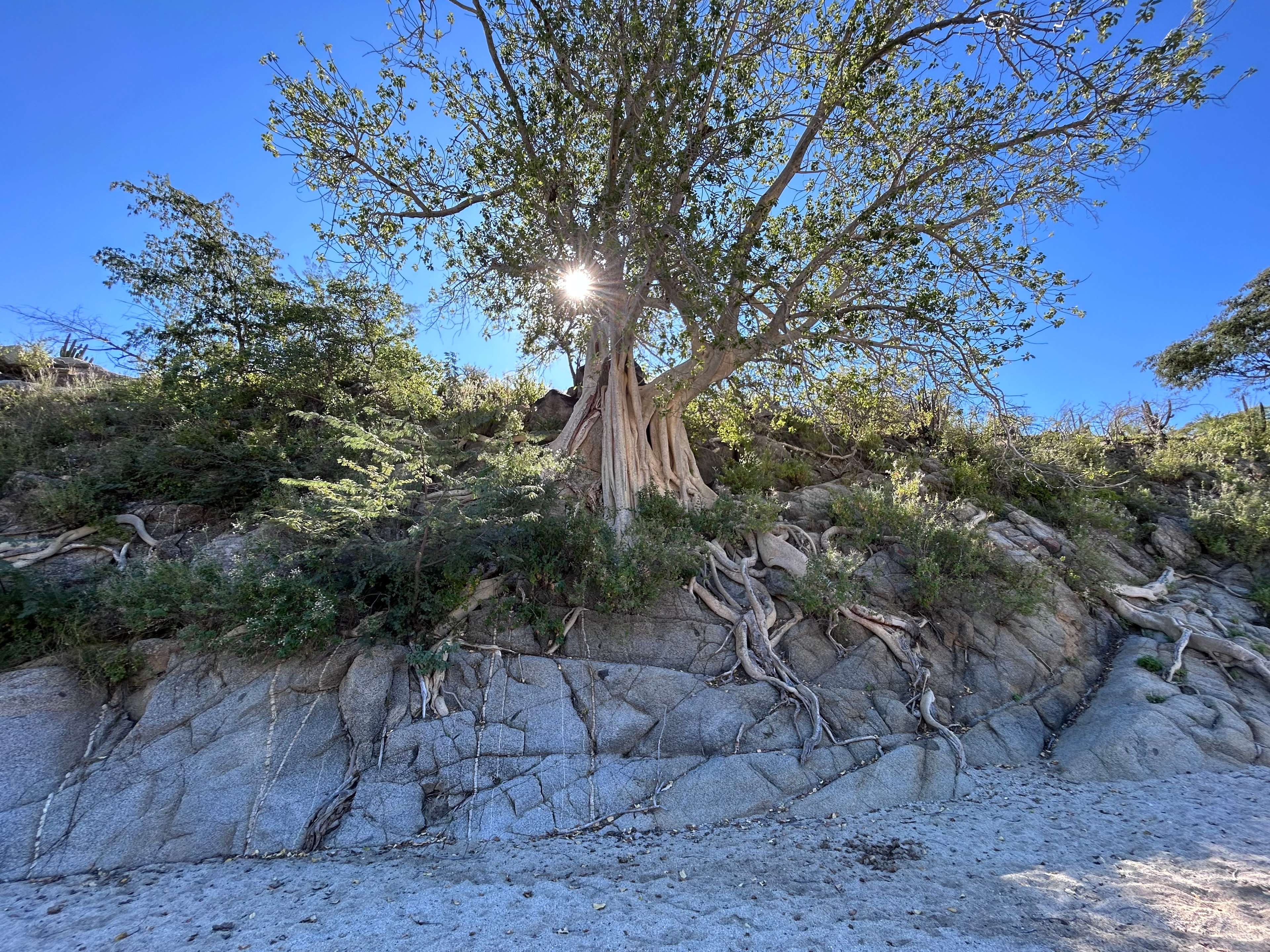
Lobelia made a big circle around the Tulip tree grove near the cemetery, delaying her further. The Tulips trees were massive, their trunks thicker than the pillars of the consortium, their crowns topping even that of Gran. Their fake-tulip buds had started to open that morning. The show was high in the canopy, mostly hidden by leaves. Humans couldn’t see it, but they could smell it. And that was the danger.
She had received the alert that morning. Everyone in Dundas had. The pheromones of their flowery mating would disorient anyone who came within ten body lengths. Those who went closer would become wavy-brained. Too close, and the effects were irreversible, even sometimes fatal. The pheromones worked across species. No one had any idea why. The scientists once thought they understood tree biology, but after the great awakening, when trees started talking to humankind, started making demands of humankind, they realized they had never understood trees at all.
Lobelia could hear the danger as she threaded through the park: the bark of trunks grinding in rhythm as the flowers did their thing. It was a little embarrassing, like overhearing your parental unit pluckety-plucking outside of procreation season, pluckety-plucking just for fun.
The arborists theorized that Tulips trees, then Magnolias, then Willows, had started laying down wavy-brain-making scent as a protection mechanism to keep humans away at times the trees could not afford to be distracted. Lobelia thought it was something else: a mean, petty humor.
Human teens still dared each other to get close to the Tulips during bark-rubbing season. It would probably happen again this evening. A few teens, probably boys, would sneak in after curfew and dare each other to get close. One would go too far, get too high, and then try bark-rubbing himself. It was a particularly ludicrous thing for a human to do.
They showed a video of it during prowler training: a teenaged boy rubbing himself vigorously all over a Birch tree, six body lengths away from a Tulip tree in heat. He had shed all protective coverings and his skin was streaked red with rash and blood. No one laughed when they showed the video, but Lobelia thought it was funny, a little. And she was certain that Tulips thought making human teens go into heat was funny too.
She jogged far around the Tulip grove and reached Gran with the sun still a hand’s width above the hills.
Plenty of time.
She swung herself up the metal scaffolding erected beneath and between the massive limbs of the ancient Oak, reaching the second-highest platform in three fluid leaps, then stretched out and gazed up at the quiet frenzy of Gran’s crown. This was Lobelia’s favorite viewing platform.
When she was little, she had lain on the dirt beneath the Oak and felt its roots below her. That wasn’t allowed any more. It gave the trees too much power. Platform rules were very detailed. None of the scaffolding went any higher than two body lengths. Lobelia did not know if that was because the trees forbade it, or because Supervisor again thought the proximity gave trees too much power over the humans they had taken to calling their subjects. She would never know. She didn’t care.
Lobelia slid sideways on her back until she was lined up under Gran’s third-largest limb. Gran had allowed moss to find purchase on one side of this northwest bough and in the crevice where the limb met the trunk, the region Lobelia thought of as Gran’s armpit.
Lobelia worked her toe-covers off with her left heel, wrapped her legs around the branch, and pressed her bare soles hard against its rivulets of grey bark. She closed her eyes and lifted her hands. The limb was only an ear-span away from her face. She placed her palms flat on the bark above her.
Soon she could feel Gran’s pulse, the liquids she was drawing up and sending down, her business at this time of change from light to dark. Lobelia lay on the platform, the metal cold on her back, her soles and palms and the insides of her thighs warm with the activity of Gran’s life, and waited.
Sometimes the Oak talked to her. Sometimes it did not. Lobelia had assumed for years that it was something she did that triggered a tree to talk to her: how she addressed it, the scent she carried, her cycle of blood in relation to the moon, what she had eaten that day, or the gestures that accompanied her greeting. But it was none of those things. She wasn’t in control of the conversation. It wasn’t about her. The trees talked to her — Gran talked to her — when they had something to say.
Supervisor could have told her that too, probably, but didn’t. Of course.
Lobelia clasped that bit of Gran between her legs until she could feel the Oak getting ready for darkness. She wanted to ask Gran about the cyclist who said he was a stupid God, but the tree wasn’t talking. Not today.
Lobelia opened her eyes slowly. It was a hard shift, taking her mind from inside the cellulose telegraphs of Gran back to the day-darkening world. And it was almost night. The sun was hidden behind the hill, the sky edging toward deep-water blue. Lobelia leaped from the platform and ran for the boundary.
The electric floating bugs were already streaming into the park from its dark forested side. Ah. There it was, that feeling that drew her back to the Gran tree again and again. Gran hadn’t talked to her, but she had filled Lobelia with the knowledge of her own human magic. Lobelia leaped for the boundary fence and felt the familiar, delicious rush of unexpected flight.
There. That was it. Freedom.
Why didn’t you withdraw his breath-node immediately when he proclaimed himself?
“Only a wavy-brain would proclaim themselves to a stranger. The Tulips were mating. He had clearly veered too close, perhaps inside their boundary, and his human integrity was compromised.”
She had practiced the answer. Not out loud, of course, but had rehearsed it in her head. It was the obvious answer and mostly true. He was just a lonely wavy-brain.
She knew Supervisor would ask. Of course it would ask. And, sure enough, there was the blinking light when she woke up: consultation required. The normal thing, the easy thing, was to link the Supervisor to her implant. Then they could converse in a holo-like atmosphere of an office without Lobelia exiting her living unit.
But sometimes Lobelia liked to go to Supervisor in real space, to the Dome of Knowledge and Control at city center. There was no need, no need at all. And she had no idea if Supervisor’s electromagnetic signature node was actually there, physically there, but she chose to believe that it was, or at least a part of it was, even while understanding that it was very, very unlikely that an entity so all-encompassing would choose to reside in one physical place.
Still, some part of Supervisor was in the Dome, and Lobelia sometimes wanted the experience of being inside Supervisor’s mind, just as Supervisor was so often inside hers. So, Lobelia slid the blinking light right, instead of left, indicating she would head to the Dome for the consultation.
The other times she went to the Dome, Supervisor had chosen an office imprint for their meeting. It was a fancy twenty-first century tableau. The room had a big corner window with a view that hadn’t existed for a hundred years, and chairs that appeared to be made of real plastic, even though the ban on plastic was one of Supervisor’s first universal decrees when they all finally asked it to take over.
She had expected that familiar tableau: the thick creamy carpet that tickled her toes, the holo-view with seagulls wheeling below their cubicle in the sky, the dark wooden bookshelves, the mint tea steaming on the low glass table.
Instead, she was led to a small square room with no window at all, no plastic chairs, no rug. The walls, ceiling and floor were all the same burnished grey metal, as was the single chair and table. Lobelia found the room calming, though she thought maybe that wasn’t Supervisor’s intention.
The entity had chosen not to project a form for their conversation. There was no grate or screen or variation to the metal of the walls and floor, yet there was a pleasant breeze in the room, and there was light, and Supervisor spoke clearly, seemingly through the air itself.
“Why did you choose not to explore his Godhead proclamation?”
She had practiced her answer to this question too, had known it would come. “I was on my way to see the Gran tree. Light was falling. If I stopped for inquiry, or even if I zapped him immediately, I would have lost the opportunity to sole-touch. I thought that was more important. And I knew I could always find him later, if needed.”
She had used this excuse twice before when she shucked her prowler duties to go talk to a tree instead. Using the same excuse three times with an entity like Supervisor was not wise. But, again, it was mostly, almost true. Supervisor couldn’t talk to the trees directly and there was almost nothing more important these days than the ability to communicate the desires — no, the demands — of the Arborphren. Supervisor needed humans for that.
Lobelia wasn’t a translator. Those who trained could put tree thoughts into language instantly. They simply wedged a single fingertip in a tree’s bark fissure, or looped a toe around a root, and started spouting words. Human words, often a torrent of them.
It wasn’t like that for Lobelia. She could sense a tree’s emotions and roughly translate those: anger, joy, peace. And the advice she sometimes got from Gran: that was clear and often specific, but she could rarely express it in words. Sometimes the trees — mostly Gran, but sometimes others — told her what they were thinking, not just what they needed. It was like eavesdropping on a conversation. Sometimes, with her soles snugged up against Gran’s bark, she felt like a sleepy child listening to adults talking in a room down the hall. She understood bits and pieces, but never the whole.
She had always known how the term “awakening” irritated the Arborphren. She knew that long before Supervisor abolished the term. To say that trees had “awakened” was to place their consciousness in relation to humanity and that was all wrong. They were awake and conscious long before people existed. They had decided to reveal that fact only when they realized humanity was likely to destroy their planet, and when there was finally an entity that could help them stop the global calamity of humankind.
The “awakening” was forceful. Very. But now there was peace with the trees. Supervisor had helped a lot. The ban on plastic was an important first step.
Lobelia could also sense the trees’ social structure and politics. The translators knew only what the trees asked them to translate, but Lobelia could sense, for example, that Gran did not like the Tulips much. Gran still fed them, when necessary. The old Oak sent minerals to the grove after the Tulip blossoms fell and their fruit began to swell. But Lobelia suspected the Gran tree talked more to her, the scrawny human prowler, than she did to the showy Tulips across the park.
“And what did Gran tell you?”
Lobelia hadn’t thought through the conversation this far; she should have known that Supervisor would ask. “She was distracted by the Tulips too. She seemed uneasy, not about the Tulips, about something else, but she didn’t talk to me.”
Supervisor couldn’t talk to trees and talking to trees was now essential to the health of them all. Most of the negotiations these days were over language. It had started with the ban on the term “awaken” but now the trees were demanding changes not just in how humans referred to the Arbor-world, but how humans referred to the entire universe, even their own species.
The ban on metaphor had been phased in slowly but was now complete. It was a demand that Supervisor understood at once and supported. Supervisor said the trees wanted humans to start appreciating reality, but the Arborphren was more specific: it wanted humans to start seeing reality. Trees believed that metaphor was a trick humans used to shield themselves from truth.
The problem was that humanity could perceive aspects of reality that Supervisor and the Arborphren could not. Both had come to recognize that fact, grudgingly and with suspicion, and only by first realizing how much their own comprehension exceeded that of humankind. Gran could sense a hurricane two oceans away; could detect a shift in the axis of the earth; heard the magnetic signature of monarchs on their migration. Lobelia would never sense any of that.
But Gran could not even understand the idea of color, much less see it. Gran did not understand the concept of a building, or a bicycle, or the process of creating something that was not aware of its own soul. It made sense that animals who scurried across the earth could perceive shades of reality denied to the Arborphren, but trees put very little value on that knowledge. Even Gran.
Supervisor understood buildings and bicycles but was lost and blind to other forms of human knowledge. Supervisor had come to accept what it called magic: provable phenomena for which there was not yet a scientific explanation. For example, Supervisor knew that Lobelia could fly (only in short bursts and never higher than the canopy) even though its current understanding of physics did not explain Lobelia’s ability to rise in the air.
But Supervisor knew that her calculations would eventually reveal the physics of human flight — and all other forms of magic. Magic was not a mystery; it was simply science unrevealed. True mystery was not tolerated by either Supervisor or the Arbor-world, and that included Gods.
Thousands had popped up since the trees started speaking to humanity. Many believed the epidemic of divinity to be a side effect of cross-species communication. Most of the Gods died quickly. In fact, Godhead was mistaken as a disease at first. The body-tenders looked for a pathogen. It could happen at any age. But those who didn’t wither within a moon curtain or two grew very strong, very quickly, and were almost impossible to kill.
In the first generation after tree-speak, Immanuel Kant had gathered 40,000 followers and almost completely destroyed the Acacias of the Upper-Veld. Supervisor set up the Prowler Corps to find and extinguish the new Gods as they arose. The longer a God lasted, the closer it came to immortality.
Few people had the talent to be prowlers. It took special training, and a very special wand, to withdraw the breath node of a mature God. No one objected to the plan. They knew what the trees would do if humanity balked at killing their own. So, Lobelia was a prowler, a third-generation prowler. That was her main job, but she also reported back to Supervisor on the mood of the Arborphren in Dundas. That was her job too.
“He wasn’t a God, Supervisor. He didn’t glow. He was not being followed. No one looked at him at all. He was just a wavy brain.”
“You are wrong.”
Supervisor’s words tumbled into Lobelia and rested low in her abdomen like something bad she had swallowed by mistake, something that would stay there and grow and be a problem for a long, long time. She had known he was a God. Of course she had known. That is why she stopped to answer when he asked her to wish for his death under the evening sky. A small compulsion, a tiny one, but he had moved her to action against her will.
“I am sorry Supervisor.”
And what now? What happened when a prowler failed to do her job? Was her magnetic signature also about to be withdrawn?
“His name is Lev.”
“Drink please.”
She could feel the compulsion like a tickle; it made her want to drop her wand and reach for the delicate teacup on its matching green and gold saucer. The porcelain was so thin that the lone stripe of sunlight in the dark room shone through the cup rim, making it glow. It must be ancient.
“It is mint tea. It is good.”
“No.” She held her wand steady, pointed at the torso of the God that Supervisor had told her went by the name of Lev.
He smiled. “Good! See? You do not have to do what I say. You have your own will.”
“Do not play mind games with me old man. I know you are a God.”
“Of course I am a God. I told you that when we first met. And you are here to kill me. Of course. We will get to that part. But first we have a few things to do.”
Why hadn’t she twisted her wand? Why was he still talking? Why wasn’t his magnetic shadow already in her A-belt, or at least flowing through her palm web? He should be slumped in that chair, ready for the retrievers.
“Are you sure you don’t want some tea?”
Lobelia barely managed to shake her head. He pulled the cup across a small wooden box that served as a table, took a sip, closed his eyes, and recited a quiet incantation that Lobelia could not hear. He was a powerful God. Lobelia had misjudged him, badly.
The key to a successful raid was action. Twist your wand as soon as the God is in sight; give it no chance to inflict its compulsions on your humanity. But she had hesitated. She had hesitated for almost half of a full second and now she had lost control. Why had she done that? Was it him, or was it something in her?
Her family name carried the honor of having silenced thirty-four Gods; few knew that Lobelia alone was responsible for eighteen of those silencings. Eighteen, but this had never happened before.
“Tell me, Lobelia, what do you want?”
She recognized the trap immediately. It was always the way Gods got people, by offering them what they wanted most. And yet, she was compelled to answer.
“I want to know why you were pushing a bicycle.”
The God named Lev clapped his hands, threw back his head and laughed. “Wonderful! Curiosity! You have curiosity, Lobelia. Such a rare thing among humanity and Gods too. And so valuable. You actually want to know things.”
Lobelia strained again to turn her wrist, twist the wand to open the stream that would withdraw his magnetic shadow first, and then his life juice. But she could not do it. He was in control.
“I like wheels Lobelia. I like the feel of a wheel rolling along a smooth surface. They are wonderful. Things that spin, turn, roll; they give me joy. Bicycles are my drug, really, even though I never learned to ride. I am told I have no balance. I was walking the bicycle through the Driving Park for pure pleasure.”
“Why are you telling me this? If I fail today, Supervisor will send another prowler and they will see this holo first. They will know to not even come inside.”
“No, they won’t.”
“Why?”
“The walls protect me. Supervisor cannot see us now. There will be no holo of our meeting.”
“The walls?” Lobelia did not take her eyes off the God before her, but she could see the wall behind him: standard wood slat. Mid-grain, repurposed tree wood. A gap where a bar of sun was streaming through.
“The wood walls? You are surrounded by tree matter. And trees don’t like Gods. They really, really don’t like Gods.”
“And yet it is true.”
“That makes no sense.”
Lev took another sip of mint tea and put down the cup. “Not everything makes sense Lobelia. The belief that it does is a compulsion too. The ruling compulsion of our age is that all can be explained, all can be categorized, that there is always a linear relationship between cause and effect.”
Lobelia hoped he was right about the walls shielding their encounter from Supervisor. The entity would not tolerate the survival of such ideas. Just hearing such thoughts would be enough to get her killed too.
“But no need to send another prowler. You are going to kill me soon.”
“You are a very powerful God, to hold me off this long, despite my talent and my training. When we met, why did you say that you are stupid?”
“I am. I was a stupid man and now I am a stupid God. Lobelia, I have something important to tell you and the only way I could figure out how to do it was to lure you here behind my shielded walls, lure you in here to kill me. If I were a smarter God, I would have found a better way.”
Lobelia’s wrist was starting to tingle in pain from the effort of trying to twist her wand. She relaxed the effort slightly, realizing she wasn’t going to win this battle through effort, and might tear a tendon if she kept trying.
“I don’t want to hear what you want to tell me.”
“Is that true Lobelia? You have proven yourself a curious one. No matter. I am going to tell you anyway.”
He drained the tea from the beautiful cup and placed it gently on its saucer. He made a tent of his palms, looked up at his assassin and uttered one simple sentence.
“You too are a God.”
She didn’t know if he had flicked her wrist himself or if he had simply released his hold over her will and her straining flesh had followed its own momentum. He was gone in an instant, his magnetic shadow stored safely in her bio belt, his life juice also humming at her waist, and she had no chance to ask him what he meant, no chance to satisfy her curiosity at all.
Lobelia lay in the dirt staring at the brush of stars playing peek-a-boo with Gran’s rustling crown. She was in her childhood spot, the place she had first met Gran, long before the final war and the many decrees delineating tree-human contact.
Now it was forbidden to lie on the ground beneath a tree and forbidden to stay in a tree-dense zone after dark. She was breaking both laws. She would be outcast or imprisoned if anyone found out, but it was worth the risk. She had to know.
Supervisor had said nothing. The retrieval crew had shown up promptly with a clean cart. Lev’s deposits were made without incident. Supervisor had said nothing about the extinguishment itself, said nothing at all about Lobelia’s succumbing to the God’s compulsion, nor anything about Lev’s odd and dangerous conversation.
Had the killing really been shielded from Supervisor’s knowledge? Lobelia could not even imagine how that could be possible, or the power it would require.
Days passed, a week. Lobelia patrolled but encountered no more Gods or God-signs. And Supervisor was quiet. And yet, that last sentence of the God named Lev, that last horrible sentence.
She had avoided trees since killing Lev. If she was a God (which she wasn’t, that couldn’t be possible), if the trees thought she was a God, they would report her through a translator and another prowler would come for her right away. The trees would be able to tell, of course they would. But if she was a God (impossible!), she would be dead soon anyway. New Gods rarely lasted more than two moon curtains after hatching.
So, she didn’t touch a tree for one day, two, three, six. On the ninth day, she realized that was not a life. God or not, she didn’t want to walk the earth without the chance to sometimes snug up against the bark of something very different from herself and feel its juices sing.
So here she was lying in the dirt where she first felt a tree, where she first met Gran, breaking the law, and waiting for redemption.
She felt it right away, a tingle in her spine, as if Gran’s roots were filling the gaps between her vertebrae. It had been so long since she felt that part of Gran, the dark part that lived in blackness, that shuddered through the earth in every direction except for up, that was the tree’s connection to the underworld, to everything.
Above her, Gran’s crown undulated in the breeze: sheets of black lace billowing against a black sky. And then she was inside the tree in a way she had never been before. Gran drew her consciousness up through the trunk to the very tip of its existence, to the apical bud that controlled the whole Oak.
And for a moment, Lobelia could feel what the Oak felt there too: the distinct, unique pulse of every star in the sky. And then Gran drew her down to its deepest root, a tendril barely a hair-width’s wide lapping an underwater stream that tasted of iron. And then Gran held her in both places, and every tree-place in between.
And Lobelia could not tell if she was trembling, or if it was the Oak.
“Am I a God?”
The answer was clear, strong, delivered in a rhythm that melded with the beating of Lobelia’s heart.
“Of course. Of course. Of course.”